Commercial thesis
Agriculture is both a traditional export base and a government priority for diversifying away from oil. The World Bank reports 11.5% growth in agriculture in 2025 (World Bank). Growth is uneven: in the first half of 2026 the government estimates sugar output rose 19.3% and rice 4.4%, while other crops fell 6.4% and the sector as a whole was roughly flat at -0.5% (DPI, 2026).
The government is investing beyond the farm gate. The 2026 budget allocates GY$113.2 billion to agriculture (DPI, 2026) and a further line to expand agro-processing, with plans for an agro-processing facility at Parika and a fruit-pulping hub at Lethem (DPI, 2026). Those plans point to the gaps: post-harvest losses, limited processing capacity and weak cold chains.
Available land or a government target is not proof that a business is viable. The useful question is whether a specific product can be grown, processed and delivered to a specific buyer at a competitive cost.
Evidence
-0.5%
Agriculture, forestry and fishing, first half, H1 2026
Source: Department of Public Information, Government of Guyana, 14 September 2026
GY$113.2 billion
Agriculture allocation, 2026
Source: Department of Public Information, Government of Guyana, 26 January 2026
GY$745 million
Agro-processing budget line, 2026
Source: Department of Public Information, Government of Guyana, 26 January 2026
A 2025 study of 186 countries in Nature Food found Guyana to be the only one whose domestic production covers its needs in all seven food groups of a healthy, sustainable diet (University of Göttingen, 2025). That reflects a large food-producing base relative to a small population. It does not mean every product is competitive, or that processing and storage capacity are adequate: those remain the gaps.
7 of 7 food groups
Food self-sufficiency, Study published 2025
Source: University of Göttingen, 16 May 2025
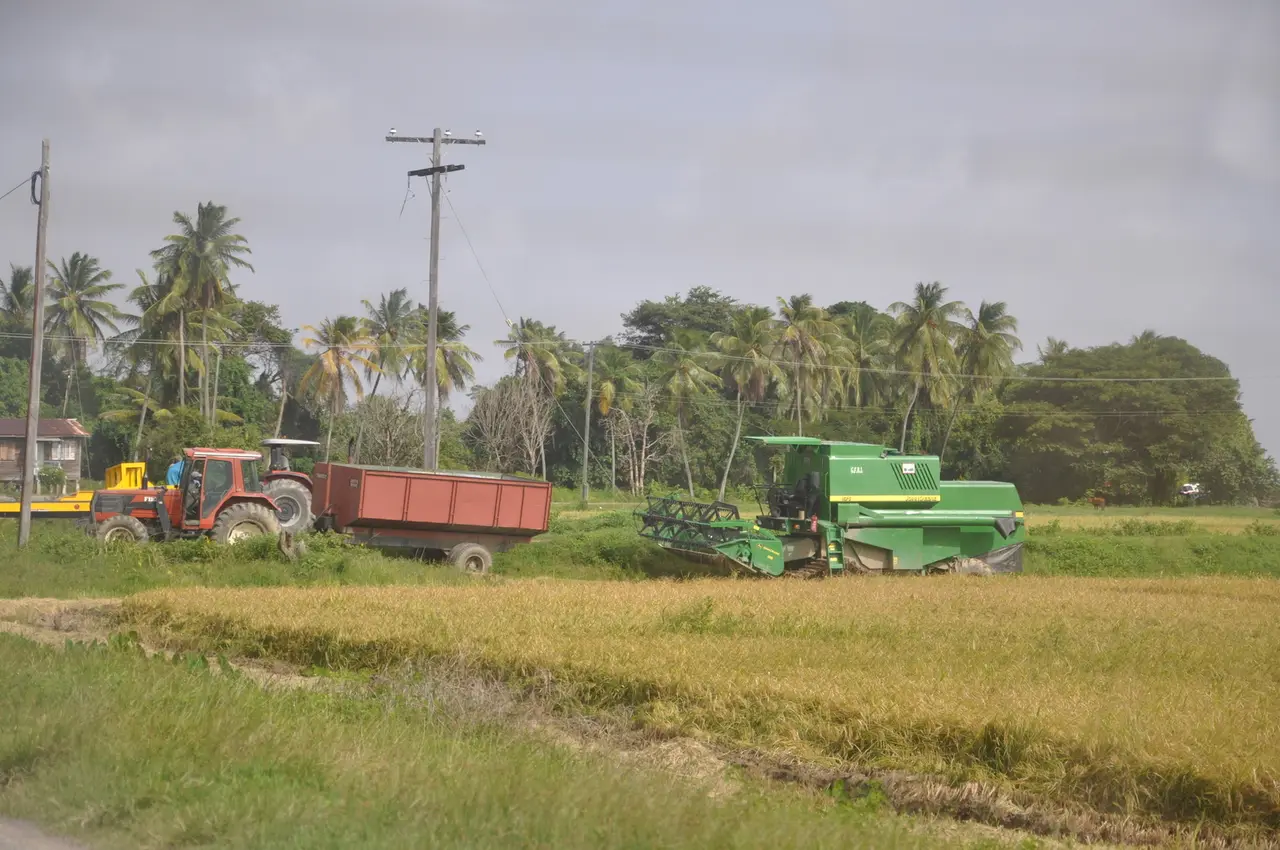
Current developments
| Development | Status | What the source says |
|---|---|---|
| Agro-processing facility, Parika | Planned | Announced with the 2026 agro-processing budget line (DPI, 2026). |
| Fruit-pulping hub, Lethem | Planned | Announced alongside the Parika facility (DPI, 2026). |
| Sugar and rice output | Reported, H1 2026 | Sugar up 19.3% and rice up 4.4% in the first half, while other crops fell 6.4% (government estimates) (DPI, 2026). |

Planned public facilities can become customers for equipment and services, or competitors for the same raw material. Which one depends on how they are procured and run, which is not yet public.
Potential opportunity categories
- Processing equipment and know-how for fruit pulping, drying, milling, parboiling and value-added products.
- Storage, packaging and cold chain: refrigerated storage and transport, packaging materials and lines, and the services that run them.
- Inputs and mechanisation: seed, fertiliser, irrigation and drainage technology, machinery dealerships and servicing.
- Food for a growing domestic market, including supply to hotels, offshore catering and supermarkets, where import substitution may be possible.
- Export logistics and certification: food-safety certification, testing and export handling for regional and international buyers.
Buyers and commercial counterparties
- Domestic food buyers: supermarkets, distributors, hotels and offshore catering contractors serving a growing economy.
- Established producers and processors in rice, sugar and other crops, as customers for equipment, inputs, packaging and services.
- Public programmes, including the planned processing facilities (DPI, 2026), as buyers of equipment and expertise.
- Regional importers in the Caribbean, where CARICOM membership can ease market access subject to product standards.
Market access and competition
The main competition for most processed products is imports, not other Guyanese processors. A project has to beat landed import prices with local costs that include expensive electricity and scarce skilled labour (U.S. ITA, 2026). For export products, the hurdle is meeting the buyer's food-safety and certification requirements at a competitive freight cost.
Agricultural land access, leases, import duties on equipment and any incentives are handled by different agencies, and terms vary by case. Treat them as questions for official sources and a qualified local adviser rather than assumptions.
Who may fit
- Agricultural technology and processing-equipment suppliers with a service model that works in a small market.
- Food processors and distributors looking for supply or a regional base, particularly with CARICOM market access in mind.
- Cold-chain, packaging and logistics operators.
- Investors in integrated projects that control the route from farm to buyer.
For most of these businesses the deciding question is who would buy, at what price, and whether that demand is real. Testing it for a specific product is the work of scoped opportunity research.
What remains uncertain
- Unit economics Electricity is expensive and skilled labour is scarce (U.S. ITA, 2026), and fast growth elsewhere in the economy competes for workers.
- Climate and drainage The coastal farming belt is low-lying and flood-prone, and the IMF lists climate shocks among the risks to the outlook (IMF, 2026).
- Logistics Interior roads are limited, which affects any project outside the coast (U.S. ITA, 2026).
- Market access Export viability depends on buyers, standards and freight costs that public statistics do not show.
- Land Access, tenure and the terms of any lease need case-by-case verification.
Key questions before entering
- Who is the buyer, at what price, and has anyone confirmed the demand?
- Can the product be produced or processed in Guyana more cheaply or reliably than imported alternatives?
- What land, water, power and transport does the project depend on, and are they secured?
- Which government programmes or facilities could help, and what conditions come with them?
- What certification do target export markets require?