Commercial thesis
Construction is one of the fastest-growing parts of Guyana's non-oil economy. The government estimates the sector grew 24.7% in the first half of 2026 and projects 27.6% for the full year (DPI, 2026). The driver is public capital spending: the 2026 budget totals GY$1.558 trillion, with GY$196.1 billion for roads, bridges and related infrastructure and GY$159.1 billion for housing (DPI, 2026).
Large works contracts usually go to a small number of international and regional contractors, often through competitive tenders financed by government or development banks. Around them sits a wider market for design, supervision, testing, specialist subcontracting, materials, equipment, and the services needed to run what has been built.
Evidence
24.7%
Construction sector growth, first half, H1 2026
Source: Department of Public Information, Government of Guyana, 14 September 2026
27.6%
Construction growth projection, 2026
Source: Department of Public Information, Government of Guyana, 14 September 2026
GY$196.1 billion
Roads, bridges and related infrastructure, 2026
Source: Department of Public Information, Government of Guyana, 26 January 2026
GY$159.1 billion
Housing allocation, 2026
Source: Department of Public Information, Government of Guyana, 26 January 2026
Where the 2026 capital is allocated
Selected 2026 budget allocations, Guyana dollars, billions. Allocations are plans, not money spent or contracts awarded.
- Roads, bridges and related infrastructure2026 · Plan or targetGY$196.1 billion
- Housing2026 · Plan or targetGY$159.1 billion
- Energy2026 · Plan or targetGY$119.4 billion
- Agriculture2026 · Plan or targetGY$113.2 billion
Source: Department of Public Information, Government of Guyana
Budget execution, not allocation, decides how much work actually reaches contractors in a given year. Public statements on completed and tendered projects are a better guide to near-term demand than budget lines.
Current developments
We separate completed projects, projects under construction, funded programmes and announcements. A selection of publicly documented projects:
| Project | Status | What the source says |
|---|---|---|
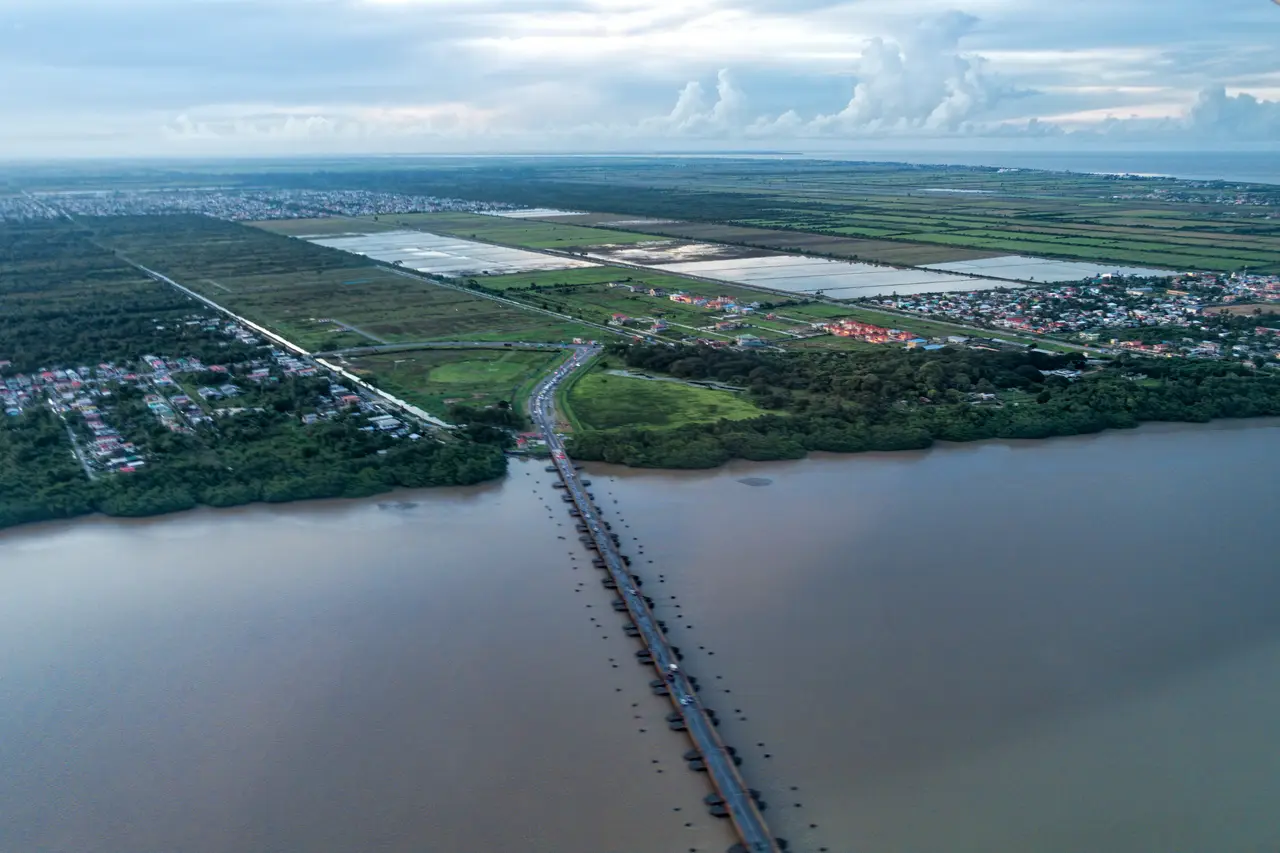
| New Demerara River Bridge | Completed | Four-lane, high-span, cable-stayed bridge; government announced commissioning on 5 October 2025 (DPI, 2025). |
| Linden to Mabura Hill road | Under construction First phase of the Linden to Lethem corridor | Upgrade of approximately 122 km of fair-weather road to all-weather standard, procured through the Caribbean Development Bank (CDB). Completion dates in public documents have moved; check the current schedule. |
| Gas-to-energy, Wales | Under construction | Power plant of about 300 MW, gas processing and transmission; targeted for completion by end-2026 (DPI, 2026). |
| Housing programme | Funded in 2026 budget | GY$159.1 billion allocation (DPI, 2026). Allocations are plans; delivery depends on procurement and execution. |
Potential opportunity categories
- Specialist subcontracting to main contractors: piling, marine works, geotechnical services, MEP, structural steel, traffic systems.
- Engineering, design and supervision, including roles as owner's engineer on publicly financed projects.
- Construction materials and equipment: aggregates and cement logistics, steel, prefabricated and modular building systems, plant hire and servicing.
- Testing, quality and compliance: materials laboratories, inspection and certification.
- Housing delivery: building systems and services that let local builders deliver more homes faster to an acceptable standard.
- Operations and maintenance of new roads, bridges and utilities once built, which outlasts the construction boom.
Buyers and commercial counterparties
- Government ministries and agencies as project owners, through public tenders. The 2026 budget sets the envelope (DPI, 2026).
- Development-bank financed projects, where the financier's procurement rules apply, as on the Linden to Mabura Hill road (CDB).
- Main contractors, which buy specialist subcontracting, materials, plant and services for the works they win.
- Private developers of commercial, residential and industrial buildings, a market that follows wider economic growth but is less documented in public sources.
Market access and competition
Large works contracts usually go to a small number of established contractors. Large Chinese, Brazilian, regional and local contractors are already present, and the U.S. government describes complicated submission criteria and opaque selection in public tenders (U.S. ITA, 2026). Eligibility for a development-bank tender depends on that bank's rules, not only on Guyanese law.
For most international firms the realistic entry is as a specialist subcontractor, supplier or consultant to a contractor that already holds work, or in partnership with a Guyanese firm. Company registration, tax, work permits and contract terms each need professional advice in Guyana before you bid.
Who may fit
- Specialist contractors and consultants with experience on development-bank financed works and their procurement rules.
- Materials, equipment and building-system suppliers prepared to work through local distributors or set up local stock.
- Firms able to partner with Guyanese contractors to add capability rather than compete head-on for main contracts.
Which of these routes suits your firm, and whether any is worth pursuing yet, is the question an opportunity fit assessment is designed to answer.
What remains uncertain
- Procurement transparency The U.S. government describes complicated submission criteria and opaque selection in public tenders, and notes that awards are not always final (U.S. ITA, 2026).
- Overheating The IMF lists overheating pressures among the risks to the outlook (IMF, 2026), which can mean rising costs for labour, materials and land.
- Payment and schedule risk Project timelines in public documents have slipped before. Model cash flow for delay.
- Physical conditions Much of the population lives on a low-lying coast prone to flooding, and much of the interior has never had paved roads (U.S. ITA, 2026).
Key questions before entering
- Are you targeting main contracts, subcontracts or supply, and which buyers actually decide each?
- Which of the relevant projects are funded, tendered and under way, rather than announced?
- Do the financiers' procurement rules (for example development banks) make you eligible?
- What local presence, registration or partner do you need to bid or to be paid?
- How would you manage cost inflation and schedule slippage within a fixed-price contract?