Commercial thesis
Guyana declared 484,321 ounces of gold in 2025, up 11.6% on the year before, and exported gold worth about US$1.6 billion (Kaieteur News, 2026). Roughly two-thirds of the gold declared came from small and medium-scale miners (DPI, 2026), and the rest mostly from one large foreign-owned mine, Aurora (Kaieteur News, 2026).
That structure shapes everything. Small and medium-scale mining titles are restricted to Guyanese (GGMC, 2024), so a foreign investor cannot simply acquire a claim and start work. The routes in are a joint venture with a Guyanese title holder, made by private contract (GGMC, 2024); a prospecting licence for larger areas, which foreign companies may apply for (GGMC, 2024); or supplying the industry with equipment, processing and services.
The people who know where workable ground is, how a dredge operation is run and which titles are sound are mostly Guyanese miners with long experience in the interior. For an outside investor, the value of a project depends as much on the partner and the title as on the gold.
Evidence
about 317,000 ounces
Gold declared by small and medium-scale miners, 2025
Source: Department of Public Information, Government of Guyana, 11 February 2026
Who produces Guyana's gold
Gold declared in 2025, troy ounces. Small and medium-scale miners hold titles reserved for Guyanese.
- All gold declared2025 · As reported by source484,321 ounces
- Of which small and medium-scale2025 · As reported by sourceabout 317,000 ounces
Sources: Kaieteur News; Department of Public Information, Government of Guyana
Current developments
The government's stated 2026 priorities are branding Guyana's gold, reducing mercury use, and opening land to small miners through structured allocations and lotteries in Regions One, Seven and Eight (DPI, 2026). Guyana is a party to the Minamata Convention on mercury, and the minister has said mercury-free recovery systems can lift gold recovery from about 35 to 40% to as much as 70% (DPI, 2026). Licensed operators can import equipment, supplies and materials for gold production free of duty (U.S. ITA, 2026).
Potential opportunity categories
- Joint ventures with Guyanese title holders: capital, equipment or technical capability in exchange for a share of production from small or medium-scale titles.
- Exploration under prospecting licences: larger-area exploration by companies with geological capability and patient capital.
- Mercury-free recovery and processing: equipment and services that help miners meet the government's mercury-reduction aims while recovering more gold.
- Equipment, parts and finance: dredges, excavators, pumps and their servicing, sold or leased to small and medium-scale operators.
- Services to mining districts: logistics, fuel, assaying, security, environmental and reclamation work.
Buyers and commercial counterparties
- Guyanese title holders, the people a foreign investor contracts with in a joint venture (GGMC, 2024).
- The Guyana Gold Board and licensed dealers, through which small and medium-scale gold is declared and sold (Kaieteur News, 2026).
- Large-scale operators, such as the Aurora mine (Kaieteur News, 2026), as customers for equipment and services.
- Village councils, where ground lies on titled village land (Amerindian Act).
Market access and title structures
Small and medium-scale titles are restricted to Guyanese (GGMC, 2024). Foreign participation therefore runs through a joint venture with a title holder, a prospecting licence for a larger area, or supply of equipment and services to the industry. Each route carries different obligations, and the summary on this page is not a substitute for the current rules from the Guyana Geology and Mines Commission and advice from a Guyanese mining lawyer.
Titles at a glance
150 to 1,200 acres
Medium-scale prospecting and mining permits, Current rules
Source: Guyana Geology and Mines Commission, 15 August 2024
500 to 12,800 acres
Prospecting licences, Current rules
Source: Guyana Geology and Mines Commission, 15 August 2024
A small-scale claim measures 1,500 by 800 feet, or one mile of a navigable river (GGMC, 2024). Large-scale mining licences are a different order of investment, with their own technical and environmental requirements.
Mining on Indigenous village land
Where ground lies within titled Amerindian village lands, the Amerindian Act sets the terms for mining there (Amerindian Act):
two-thirds
Village consent for mining on village lands, Law in force (L.R.O. 1/2012 text)
Source: Government of Guyana (consolidated text, L.R.O. 1/2012, via FAO FAOLEX)
at least 7%
Tribute to the village, Law in force (L.R.O. 1/2012 text)
Source: Government of Guyana (consolidated text, L.R.O. 1/2012, via FAO FAOLEX)
The miner must also give the village council a written summary of the project, negotiate in good faith and sign a written agreement that, by law, includes offering jobs to residents first and buying food and materials from the village where competitively priced (Amerindian Act). A project that has the community's genuine support is far easier to operate than one that has the minimum legal consent.
Who may fit
- Investors who can commit capital for several years and accept that operations depend on a Guyanese partner.
- Mining companies and geologists with alluvial or hard-rock exploration experience.
- Equipment manufacturers and dealers, particularly of mercury-free recovery technology.
- Responsible-sourcing buyers and refiners looking for traceable gold.
If you are still deciding between exposure to production and serving the industry around it, an opportunity fit assessment is the sensible first step.
What remains uncertain
- Title quality Whether a claim or permit is valid, current, correctly bounded and free of disputes can only be confirmed with the Guyana Geology and Mines Commission, not from what a seller says.
- Joint-venture terms Joint ventures are private contracts (GGMC, 2024). Control of production, gold sales, accounting and exit all need to be written down and enforceable.
- Declared versus actual output Declarations measure what passes through official channels. Smuggling exists, and production records for a specific property may be incomplete.
- Village land Mining on village land needs the village's consent and a negotiated agreement (Amerindian Act). Timelines and terms depend on the community.
- Security, health and safety These are identified as key hurdles for investors (U.S. ITA, 2026). Remote sites are costly to supply and protect.
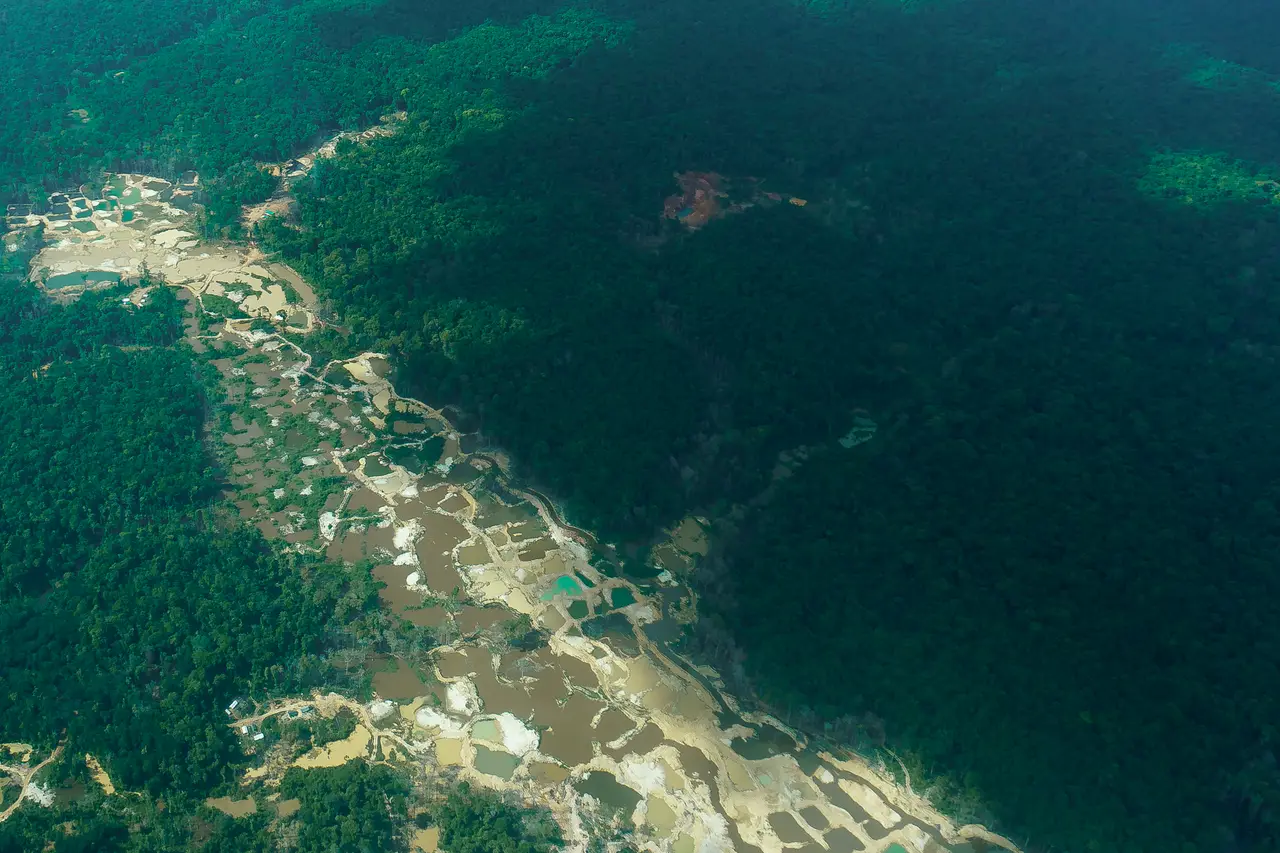
- Environment Alluvial mining clears forest and leaves tailings ponds, as in the photograph above. Reclamation and mercury rules are tightening, and buyers increasingly ask where gold comes from.
- Border claim Venezuela claims the territory west of the Essequibo River, including mining districts; the case is before the International Court of Justice (ICJ).
- Gold price Returns depend on a world price no one controls. This page does not suggest any return.
Key questions before entering
- Do you want exposure to gold production, or to the industry around it?
- Who holds the title, and has the Guyana Geology and Mines Commission confirmed its status and boundaries?
- Is the ground on village land, and what consent and agreement are in place?
- Who controls the gold, the cash and the accounts in the joint venture, and how do you exit?
- What production record exists for the property, and how was it measured?
- How will the operation handle mercury, reclamation and the security of people and gold?
Public information cannot tell you whether a particular title, partner or production claim is sound. Those questions need local enquiries and professional legal and technical due diligence before any money is committed.
Relevant official resources
- Guyana Geology and Mines Commission: land management and mining titles.
- Amerindian Act, Chapter 29:01, sections 44 to 53 on village land, leases and mining.
- U.S. Country Commercial Guide: Guyana mining and minerals.
- GO-Invest: key sectors, the government's investment-promotion agency (official priorities, not independent analysis).