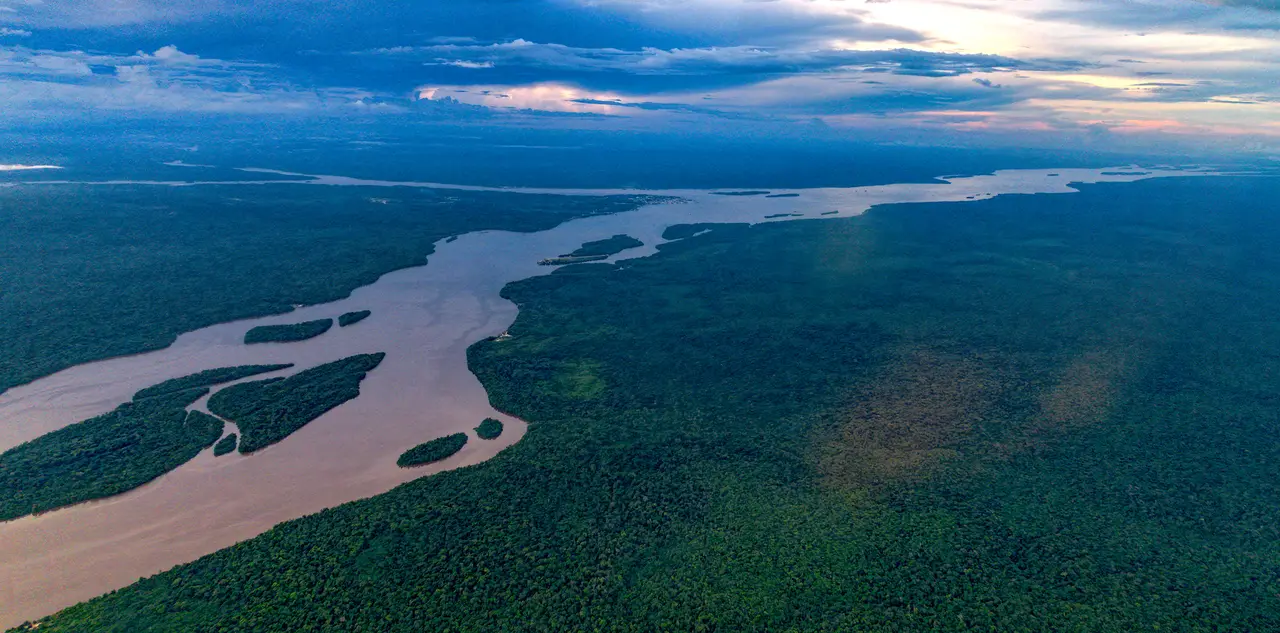
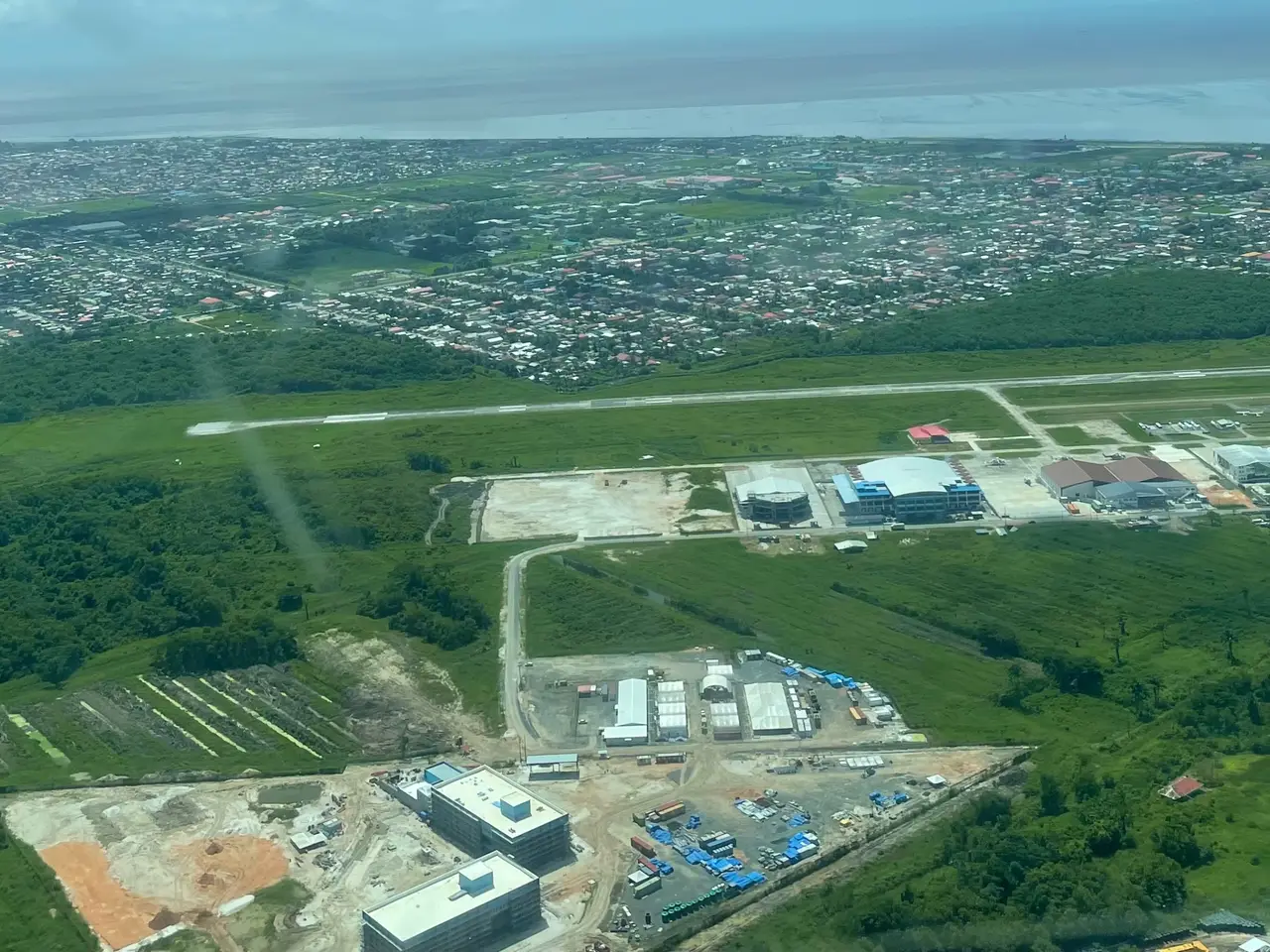
A country of under a million people has become one of the world's newest major oil producers. That is changing what the economy needs, who it buys from and where new businesses can fit.
A rapid transformation
Guyana's real GDP grew 43.8% in 2024 and 19.3% in 2025, according to the World Bank (World Bank). Offshore oil production exceeded 900,000 barrels a day in 2025 (IMF, 2026), and the operator of the Stabroek Block expects installed capacity to reach 1.5 million barrels a day once its seventh approved project is online (ExxonMobil, 2025).
Growth on this scale is mostly a statistical effect of oil output. For a business that does not sell to the oil industry, the more relevant measures are below.
The non-oil economy
14.3%
Non-oil GDP growth, 2025
Reported actual Annual real growth of the economy excluding oil and gas extraction.
The IMF reports 14.0% for the same year (October 2026); the difference reflects data vintages.
The non-oil economy grew 14.3% in 2025 by the World Bank's measure (World Bank) (14.0% by the IMF's (IMF, 2026)), and the government estimates 10.1% for the first half of 2026 (DPI, 2026). The IMF expects non-oil growth to settle at about 7% a year over the medium term (IMF, 2026), which would still be fast by international standards. Inflation was 3.3% in 2025 (IMF, 2026).
Public investment
Oil revenue flows into a Natural Resource Fund, which held around US$4.3 billion at the end of June 2026 (World Bank), and from there, in part, into the budget. The 2026 budget of GY$1.558 trillion is presented as a 307% increase in spending since 2021 (DPI, 2026). Large allocations go to roads and bridges, housing, energy and agriculture (DPI, 2026). The government estimates construction grew 24.7% in the first half of 2026 (DPI, 2026).
What this means for business
Our reading of the evidence, which is analysis rather than reported fact:
The buyer is often the state or the oil industry. Much new demand originates from public projects or from the operator and its contractors. Understanding their procurement is more important than consumer market size.
The market is small, but the budget is large. A population of under a million (World Bank) limits consumer markets, while public and industrial spending is large relative to the economy.
Capacity is the binding constraint. Skills, power, housing, logistics and professional services are stretched. That is both the opportunity for suppliers and a cost for anyone operating locally.
Local participation is policy. Local-content rules in the oil sector, and a preference for Guyanese participation more broadly, mean many entries work best through partnership.
Risks and limits
Dependence on oil The IMF names oil-price volatility, overheating pressures and climate shocks as downside risks (IMF, 2026).
Doing business The U.S. government reports unreliable power, poor interior roads, opaque public procurement, scarce skilled labour and a conservative banking sector (U.S. ITA, 2026).
Border controversy Venezuela claims a large part of Guyana's territory; Guyana brought the matter to the International Court of Justice (ICJ). Investors in the west of the country should follow it.
Statistics move Mid-year estimates and projections are revised, and different institutions publish different figures for the same year. We date every number for that reason.
Official support
The Guyana Office for Investment (GO-Invest) is the government's investment-promotion agency and offers investment facilitation (GO-Invest); the government portal describes its facilitation and advisory services (Government of Guyana). InvestingGuyana.com is independent of both and complementary to them: we research whether and where an opportunity fits your business, which an investment-promotion agency is not set up to do impartially.
What could Guyana mean for your business?
Tell us what your business does and what you are exploring. We will review your objective and tell you whether an opportunity assessment or further research is a useful next step.
Guyana: country overview and economic update. World Bank. Published date not shown; accessed 28 October 2026. No publication date shown; most recent data cited runs to June 2026.
ExxonMobil Guyana expands capacity with seventh offshore development. Exxon Mobil Corporation. Published 22 September 2025; accessed 28 October 2026. Company statements. Later press reports (March 2026) suggest some start-up dates may move earlier; not adopted here until confirmed by the operator.
Guyana Country Commercial Guide: Market challenges. International Trade Administration, U.S. Department of Commerce. Published 13 May 2026; accessed 28 October 2026. Written for U.S. exporters; some points (for example tax-treaty effects) are specific to U.S. companies.
Invest in Guyana: key sectors. Guyana Office for Investment (GO-Invest). Published date not shown; accessed 28 October 2026. Official investment-promotion material: useful for official priorities, not independent evidence of commercial attractiveness.